
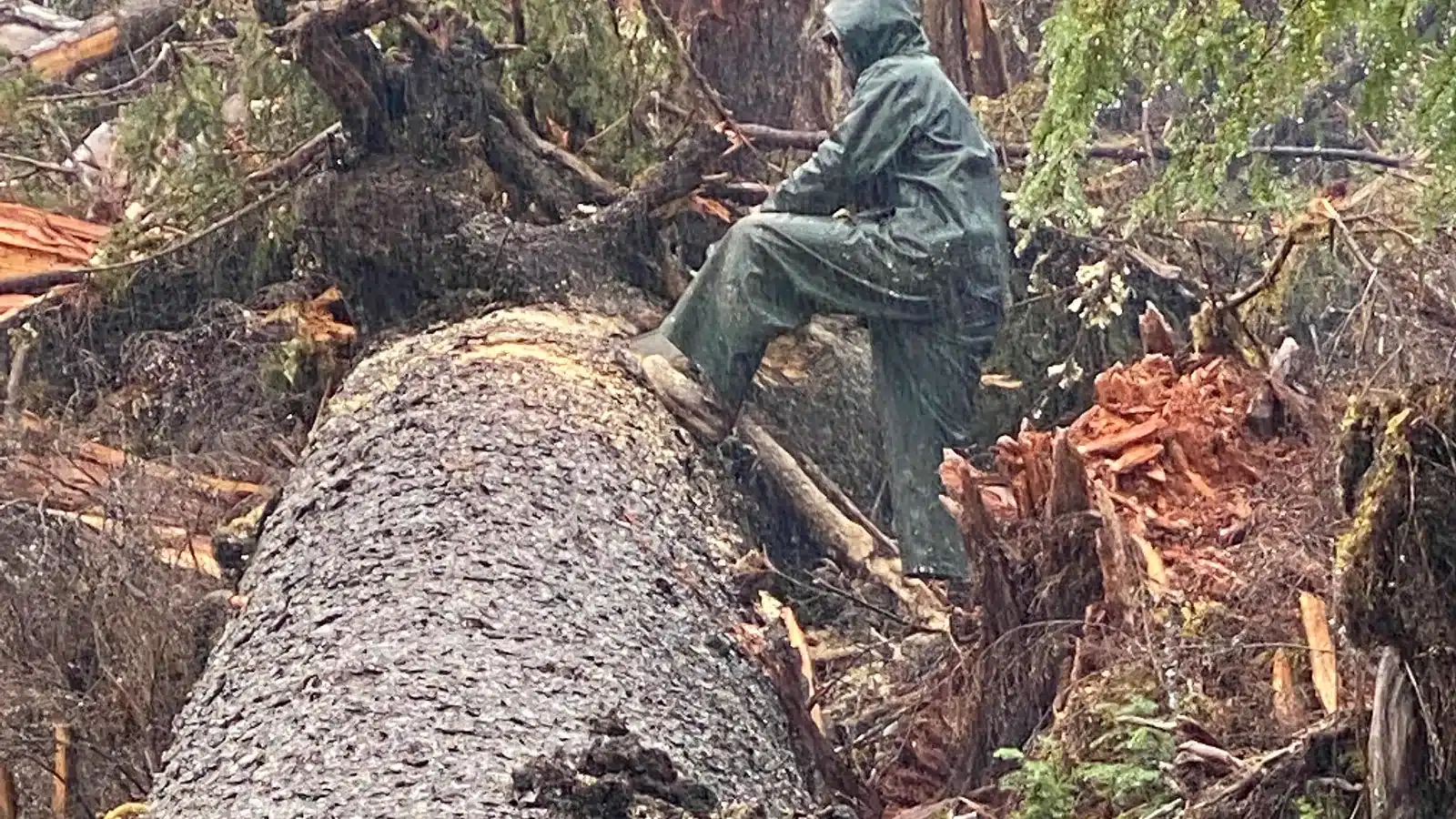
In June 2009 we flew our first helicopter salvage sale, on Shelikof Island, windfalls and dead standing Sitka spruce and red cedar we had spent two years prospecting, documenting and flagging before a single log left the woods. That is salvaged tonewood. It’s instrument wood cut from trees that are already down or dead, or from old-growth logs somebody else cut decades ago for another job (a log bridge, a logging-camp float), recovered instead of felled for the purpose.
All of our wood is salvage, Old Growth Sitka spruce and cedars out of the Tongass National Forest around Prince of Wales Island, where our family has been cutting soundboards for 30 years. We don’t buy clear-cut timber, we do cut some dead standing trees, and we have never cut a healthy living tree. In salvage we have on occasion harvested living trees that were dying and significantly compromised. The old-growth Sitka logs we salvage AVERAGE about 400 years old, and nobody can make this wood again. Here’s where it comes from, how we recover it, and what it does and doesn’t mean for a guitar top.
What Salvaged Tonewood Is, and How Much of Ours Is Salvage
Salvage is an old word in the woods. The USDA's agricultural thesaurus, quoting the Forest Service's Wood Handbook glossary, defines salvage logging as cutting "primarily to utilize dead and downed material and scattered poor-risk trees" that won't be merchantable if they're left standing until the next scheduled cut. Salvaged tonewood is that same idea aimed at instrument wood. We go after the dead and down, windthrow and dead standing snags, plus logs that were cut decades ago and put to work as bridge stringers or as the floats under logging camps, and we pull the clear, straight fiber out of them for soundboards.
Reclaimed tonewood is the same family. Some people say reclaimed for wood that already had a job, a bridge, a float, a building, and salvaged for wood recovered out of the forest (most folks use the two words interchangeably, and so do I). Search reclaimed wood guitar and you'll mostly find barn wood and old building lumber, good wood for a body or a neck. Ours differs in the way that matters for a top, it's salvaged Sitka spruce and cedar that grew slow in a rainforest that gets about 10 feet of rain a year, in logs big enough to cut wide, clear, vertical grain (VG) soundboards.
On how much of ours is Salvage, I'll be straight with you. All of it is, figured tops included: every bearclaw and other figured top we cut now comes from salvage sources. We don't buy clear-cut timber. We do cut dead standing trees, a snag that died on the stump is still good wood if somebody gets to it in time.
All of our soundboards go out under one name, EarthTone Soundboards, the Sitka, the red and yellow cedar, the Blue Boards and the rest. The name came from our red cedar, old salvage logs that time, rain and the cedar's own oils have turned some Earthy colors.
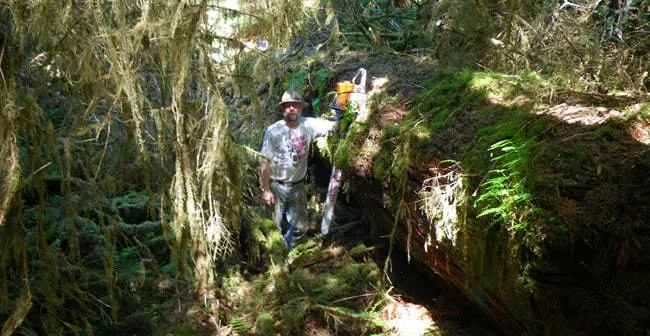
Windthrow, Log Bridges and Log Floats: Where It Comes From
Windthrow comes first because it's most of what's out there. Every fall and winter the storms come in off the Gulf of Alaska and lay old spruce down, and Sitka, Alaska's state tree, is susceptible to it.
The Forest Service's silvics manual calls blowdown "probably the most serious damaging agent of Sitka spruce," its species review says windthrow can account for up to 80 percent of the mortality in a stand, and a 1998 Forest Service study by Gregory Nowacki and Marc Kramer found wind plays a fundamental role in how Southeast Alaska's forests develop. By the time we buy a windthrown log it has usually been down 1 to 15 years (plenty have rotted or broken too badly to bother with, you learn to read that from the bark and the end grain).
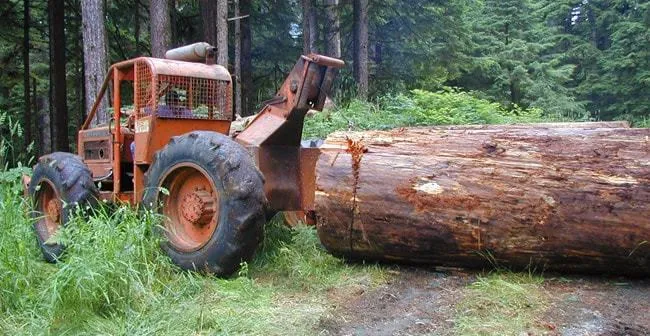
Then the log bridges. When the logging roads went into this country, creeks were crossed on big Old Growth Sitka butt logs laid side by side as bridge stringers, strong enough to carry loaded log trucks, and when a bridge is replaced the old stringers get set aside to rot unless somebody wants them.
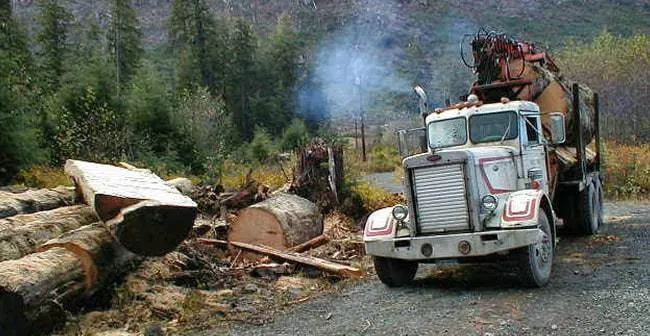
In 1998 we bought our first two salvage timber sales, bridge stringers at Upper Staney Creek from the Forest Service and a log-bridge pile from Sealaska at Black Bear Creek, and hauled them with a 1967 Peterbilt that had a 10,000 lb self-loader on it. One log out of that pile gave us the Ultra Light sort from bridge stringers.
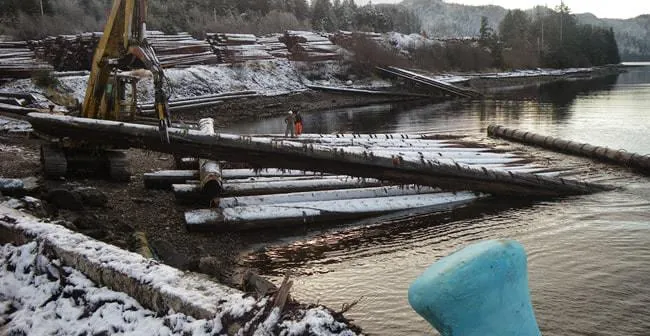
And the log floats. For decades the logging camps in Southeast lived on floats, houses and shops built on rafts of big old-growth spruce logs so a whole camp could be towed to the next sale, and those logs sat in salt water the whole time. We bought a Louisiana-Pacific log float at auction in 2000, three Gildersleeve camp float decks in 2011 that we dismantled in Klawock, and in 2015 an old Alaska Pulp Corporation camp float at Port Protection, 70 feet wide x 110 feet long, 16 logs in the water and 3 head sticks lashed with 1¼" galvanized cable.
In 2017 the ASW crew cut it in half lengthways, a friend with a tug towed the two halves out around Labouchere Bay and through Dry Pass [less than 15 feet of clearance on each side at high tide], and after 60 hours of non-stop tow we tied up at Viking Lumber's sort yard to pull and buck the logs. Some of our Blue Boards come from Gildersleeve camp logs, that's the log-float story behind our Blue Boards. Beach and water-cured logs round out the list.
How We Recover Salvaged Tonewood Under Forest Service Rules
Most of our forest salvage comes through Forest Service sales, and a tree has to pass the rules before we can buy it. It can't be in a protected area like wilderness, an alluvial fan or wetlands, it can't be inside the buffer on a fish stream, it has to be within a boundary of the road, and there has to be a workable way to get it out.
Micro sales are the small end of salvage logging, individual standing dead and down trees reached from existing roads, the way the Forest Service described its Mitkof Island micro sales. A 2010 Craig Ranger District micro sale, to give you the scale, was about 17 dead or down trees, an estimated 21 MBF, along Forest Service Road 2150 around Polk Inlet. That's how WE log, one tree at a time.
In 2003 we bought a TimberJack skidder with a 20,000 lb winch for the micro sale contracts. When a tree can't come out whole we break it down where it lies, leave the defect in the woods and pack out bigger blocks. Some trees only come out by air. In 2008 or 2009 we hired Columbia Helicopters to fly a timber sale on a nearby remote island.
Their Boeing 234 Chinook flew 30 turns in an hour, and a week later their Boeing Vertol 107 flew out another 30 turns in 1.3 hours, to drop spots we had picked out on the beach. There we tied the logs up for the incoming tide to float them off to another bay we had picked, built a raft, and towed all the logs with our little boat navy several miles, to be pulled from the water and hauled to our log yard.
Float logs are their own kind of work, the yield is often under 50% because of shipworm. The Wood Handbook calls shipworms the most destructive of the marine borers, mollusks (several species of Teredo and Bankia) that bore into wood in salt water, and the inside of a log can be honeycombed and ruined while the surface shows only slight perforations.
E-Fauna BC, hosted by the University of British Columbia, shows the feathery shipworm at Sitka Sound, living in floating timbers, docks and boats. One float we worked was 60 feet wide, fourteen logs each 80 feet long, and one of those logs might yield only about ten guitar tops, the rest too worm-eaten and rotten to use. Salvage costs more and yields less than a deck of clearcut logs, every time.
Nothing goes to waste that doesn't have to. Correction wedges become carved-top stock and bracewood, what won't make product heats our shop (the shavings go to local poultry bedding), and everything is stickered and dried to 7 to 10% moisture, the whole routine is on our page about how we salvage and process logs.
Does Salvaged Tonewood Sound Different?
I don't play an instrument myself, so I'll tell you what I know from the wood end and what the builders say. Salvage describes where a log came from, it isn't a species and it isn't a grade. A salvaged Sitka spruce top is old-growth Sitka, and it gets judged the way any top gets judged, the ring count and how even it runs, a true vertical-grain cut, runout, stiffness for the weight. The Wood Handbook puts it plainly, the speed of sound in wood is a function of stiffness and density, and there's no recognized independent effect of species. A log's history doesn't change that math.
What salvage does give us is OLD wood. A soundboard log needs tight, even rings, and you can't get 400 rings out of a 60 year old tree. The Forest Service's silvics manual says Sitka spruce may live to 700 or 800 years, and the old growth Sitka spruce we salvage averages about 400 (more on the tree in our Sitka spruce guide). Our logs also season in the round before we open them, windthrow 1 to 15 years down, bridge and float logs 20 years or more.
Some builders do believe salvage sounds better. In 2016 KTOO reported that Tom Bedell restarted Bedell Guitars in Bend, Oregon in 2009 with a commitment to keep clear-cut wood out of every instrument, that he relies on salvaged Sitka from dead or down trees in Southeast Alaska (KTOO named us as his supplier), and that he wants to show salvaged wood sounds better. A salvaged wood guitar is his to voice, so I'll let him make that case.
What I can tell you is one Black Bear Creek stringer log gave us tops so light that Greg Maxwell of Dogwood Guitars came back for more of the "not as Pretty" ones, and that's how our Ultra Light sort started. That was one log, not a rule for all salvage.
And the Blue Boards. The blue-gray stain in those float logs is a record of where the wood has been, it doesn't tell you how a top will sound, and I won't sell it that way. Judge a Blue Board the way you'd judge any other top, by the grain, the cut and the stiffness for the weight, the voice is up to the builder's hands.
Old Growth, Clearcuts and the Future of Sitka Spruce
When I came to Prince of Wales Island in 1987 the Tongass still ran on the big pulp contracts, and I spent 9 years with Phoenix Logging Co. out of Klawock. The Alaska Department of Labor laid out the history in its October 2010 Alaska Economic Trends.
Ketchikan Pulp Company got a 50-year contract for 8.25 billion board feet and started its mill near Ketchikan in 1954, a second 50-year contract went to Alaska Lumber and Pulp, whose mill opened near Sitka in 1959, and Alaska's timber harvest peaked in 1989 at more than a billion board feet. The Sitka mill announced in June 1993 that it would close, and the Ketchikan mill closed for good in 1997. The camp float we towed out of Port Protection was one of the APC floats left over from those days.
The stands that grew the best tonewood fiber, in protected, low elevation, south facing slopes, bays and valleys, are the ones that got clearcut logged over the past 80 years, and the second growth coming back in those units won't have the ring count for a soundboard in our lifetime [or our grandkids']. That's why wide, clear old growth spruce is scarce, and it's why we don't buy clear-cut timber.
People find this page searching deforestation in Alaska, so here's the plain version. The Forest Service's glossary defines deforestation as clearing a forest to convert it to non-forest use, a farm, a subdivision, a power-line clearing. Most of the logged ground around us is growing back as forest, so what Southeast lost to the clearcuts wasn't forest so much as Old Growth, and that doesn't come back in a lifetime. The Tongass is still nearly 17 million acres and more than 1,000 islands, and Prince of Wales Island is in the heart of it.
In 2017 I told KTOO, "We are just going to be the salvage people." I'm not against loggers, I was one. If you came here looking for sustainable tonewood, those are our facts, almost all salvage, no clear-cut timber, logs that were already down, dead or cut decades ago, and you can put your own label on it. Tops cut from this wood are in our store under salvaged Sitka guitar tops, the one-of-a-kind float-log sets are under Blue Boards, and the longer family history is in our story. If you have any questions, email [email protected].
Questions and answers
What are some good tone woods for guitars?
For the top, spruce and cedar, Taylor Guitars says softwoods like those are valued for being lightweight yet strong. Sitka is the most common, with Adirondack, Engelmann and European spruce alongside it. Backs and sides are hardwoods, Taylor lists rosewood, mahogany, koa, maple and sapele, and mahogany and koa get used as tops too. Whatever the species, a stiff, light, vertical-grain board matters more than the name.
What is the most resonant wood?
There isn't one winner, but for soundboards spruce is the standard, and the Forest Service credits Sitka's high resonant quality for its use in piano sounding boards and guitars. What a builder is really after is stiffness for the weight. The Wood Handbook says the speed of sound in wood is a function of stiffness and density, with no recognized independent effect of species.
Why aren't guitars made out of oak?
Some are, Taylor's 1995 Pallet Guitar had oak back and sides from a discarded shipping pallet. Oak just makes a poor top, it's heavy for its stiffness. In the Wood Handbook northern red oak runs 0.63 specific gravity and 12.5 GPa, white oak 0.68 and 12.3, against Sitka's 0.40 and 10.8. That's roughly 60 to 70% more weight for about 15% more stiffness.
What is the rarest tonewood in the world?
The famous answer is Brazilian rosewood. The CITES countries listed it on Appendix I on June 11, 1992, the most restrictive of the three appendices, and as the Fretboard Journal explains, that bans commercial trade outside pre-Convention material. For tops the scarce thing is wide, clear Old Growth spruce. Some of our sorts are rare, like the Ultra Light from one bridge-stringer log.
Is Adirondack spruce rare?
Rarer than Sitka, yes. Adirondack is red spruce, and its old growth was logged hard, the Forest Service says about 500,000 acres of red spruce in central West Virginia in the late 1800s were down to less than 60,000 acres by 1975. Taylor Guitars says supply is creeping back as a new generation matures, though those trees are still a lot smaller. More in our Adirondack vs Sitka comparison.


Comments