
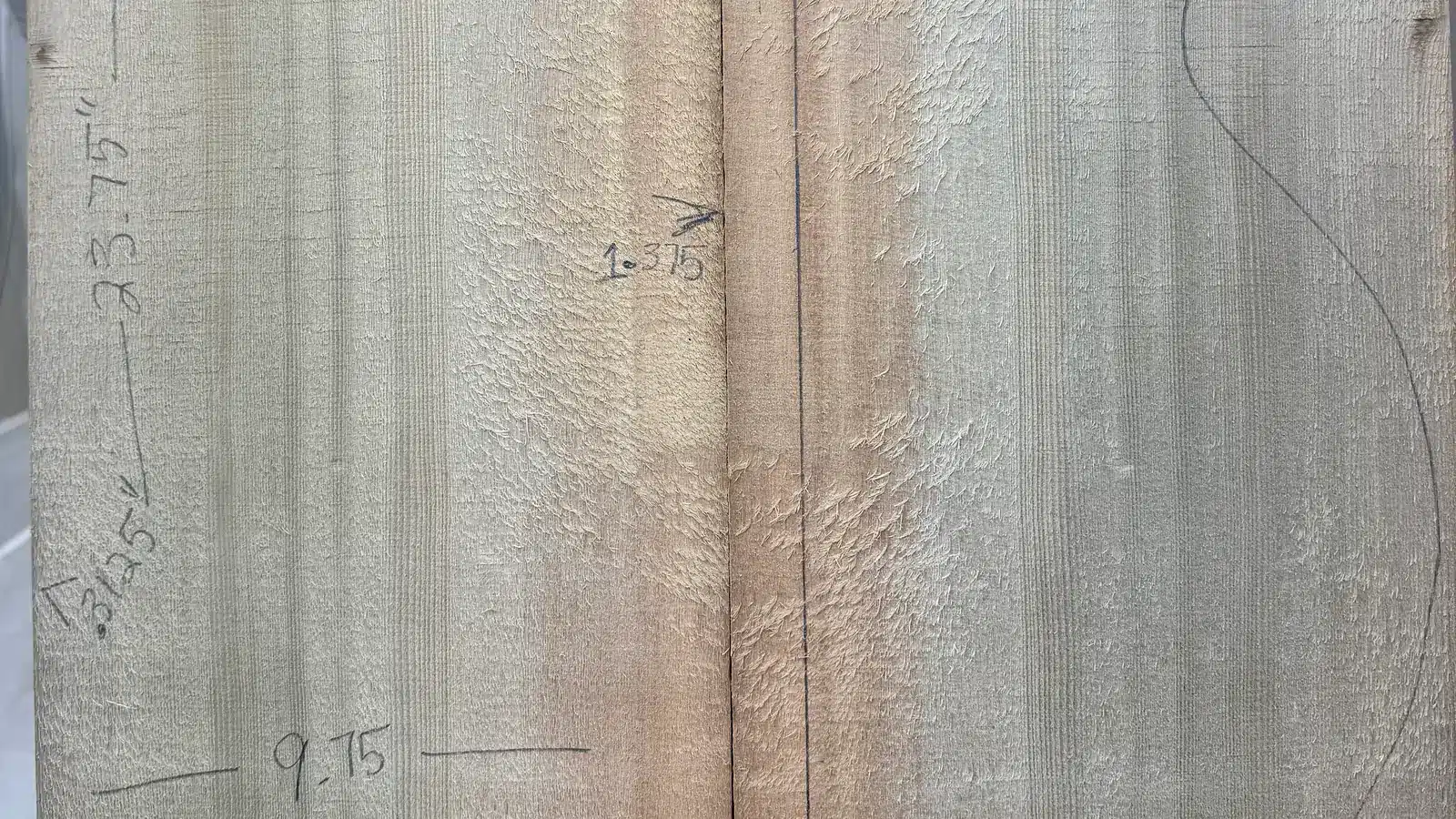
In 2000 at the World Guitar Congress in Baltimore, Bob Benedetto came to me and asked if I could supply him some toredo-eaten Sitka planks off a float log for archtop construction [toredo is the shipworm], I said yes and sent him 2 sets of plank-cut boards, and he built Toredo 1 and Toredo 2 out of them. So the wood is my end of the archtop guitar, and here’s the plain answer.
An archtop guitar is a hollow-body guitar whose top, and usually its back, is carved (or on factory models pressed) into an ARCH like a violin’s, with f-holes instead of a round soundhole, a bridge that floats on the top and a tailpiece holding the strings at the end of the body.
Orville Gibson patented his carved, arched-top design in 1898, and in 1922 Gibson brought out the L-5 with violin-style f-holes under Lloyd Loar, the guitar the big jazz bands made famous. A carved top still starts as a thick bookmatched set of spruce, and those wedges are what we cut here on Prince of Wales Island from salvage-sourced Old Growth Sitka and red cedar.
What Is an Archtop Guitar, and Why Is It Called That?
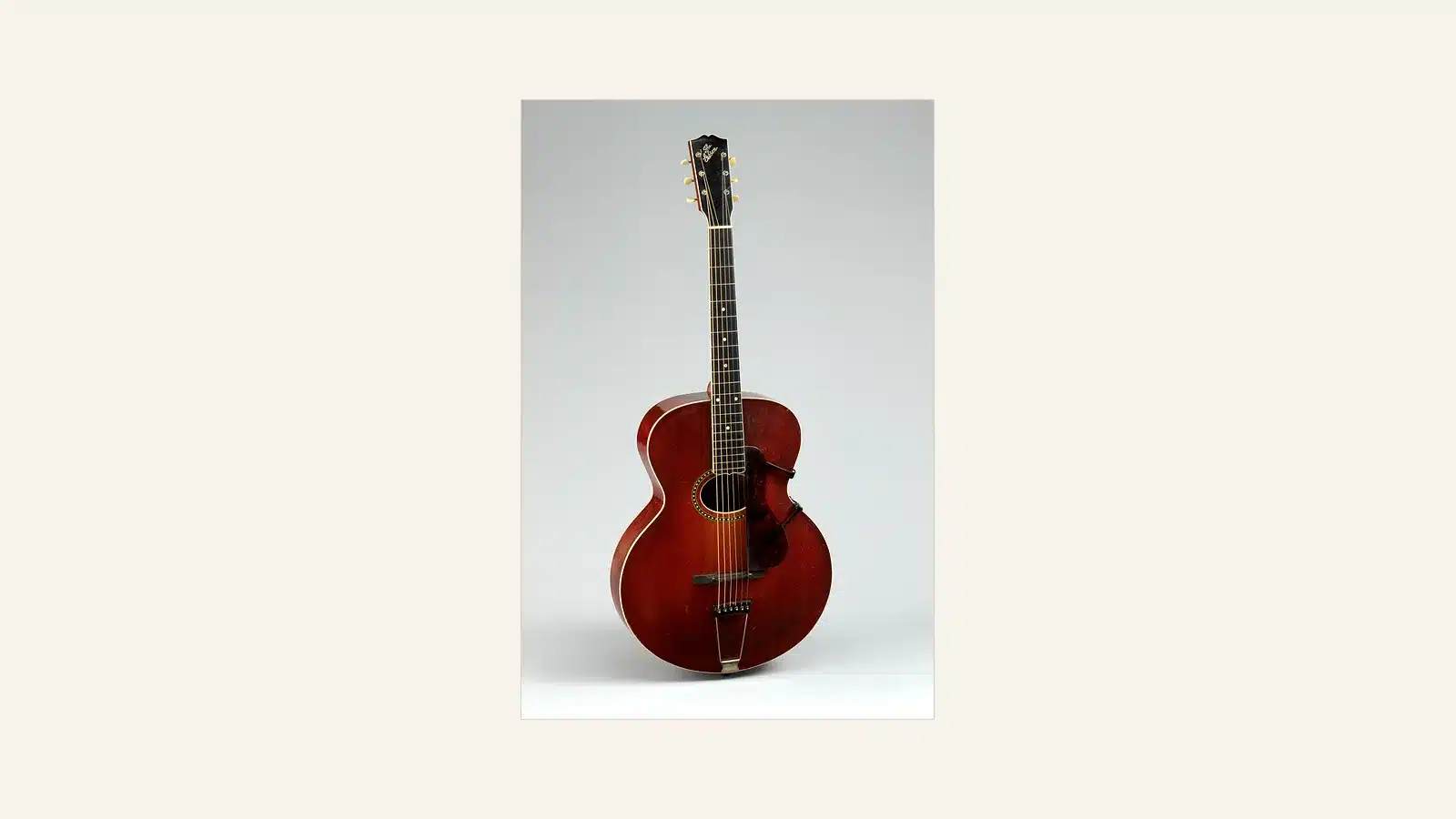
The Metropolitan Museum of Art calls the archtop guitar a distinctly American form of an old European instrument, and the main thing it borrowed from the violin is the carved, arched top and back. Look one over and the rest of the family resemblance shows, two f-holes where a flat top has its round soundhole, a bridge that isn't glued down (it floats, held in place by the strings, and can be moved and adjusted), a tailpiece at the end of the body holding the string ends, and a fingerboard riding up over the top instead of glued to it.
It's called an archtop because the top is ARCHED, where a flat top is, well, flat. Orville Gibson's 1898 patent describes the front and back boards carved in a somewhat convex form to give them proper stiffness, and thickest at and near the center. You'll see it written arch top guitar, two words, or arch-top, which is how our own grade sheet spells it, same instrument.
The arch does real work. The strings run over the bridge to the tailpiece, and luthier R.M. Mottola explains that with a floating bridge and tailpiece the string tension pushes down on the bridge and top, more so the steeper the strings break over the bridge. A flat top works the other way around, its bridge is glued on with the strings anchored in it, and Joe Wolfe at the University of New South Wales says the bracing has to keep the plate flat while the strings try to rotate the saddle.
The arch is either carved from solid spruce or, on factory guitars, pressed from laminate (more on both below). Most archtops run 16 to 18 inches across the lower bout, and our standard archtop sets are sized for 17 inch bodies and up, with smaller sets for 16 and 15 inch guitars.
Archtop Guitar History: Orville Gibson, the L-5 and Jazz
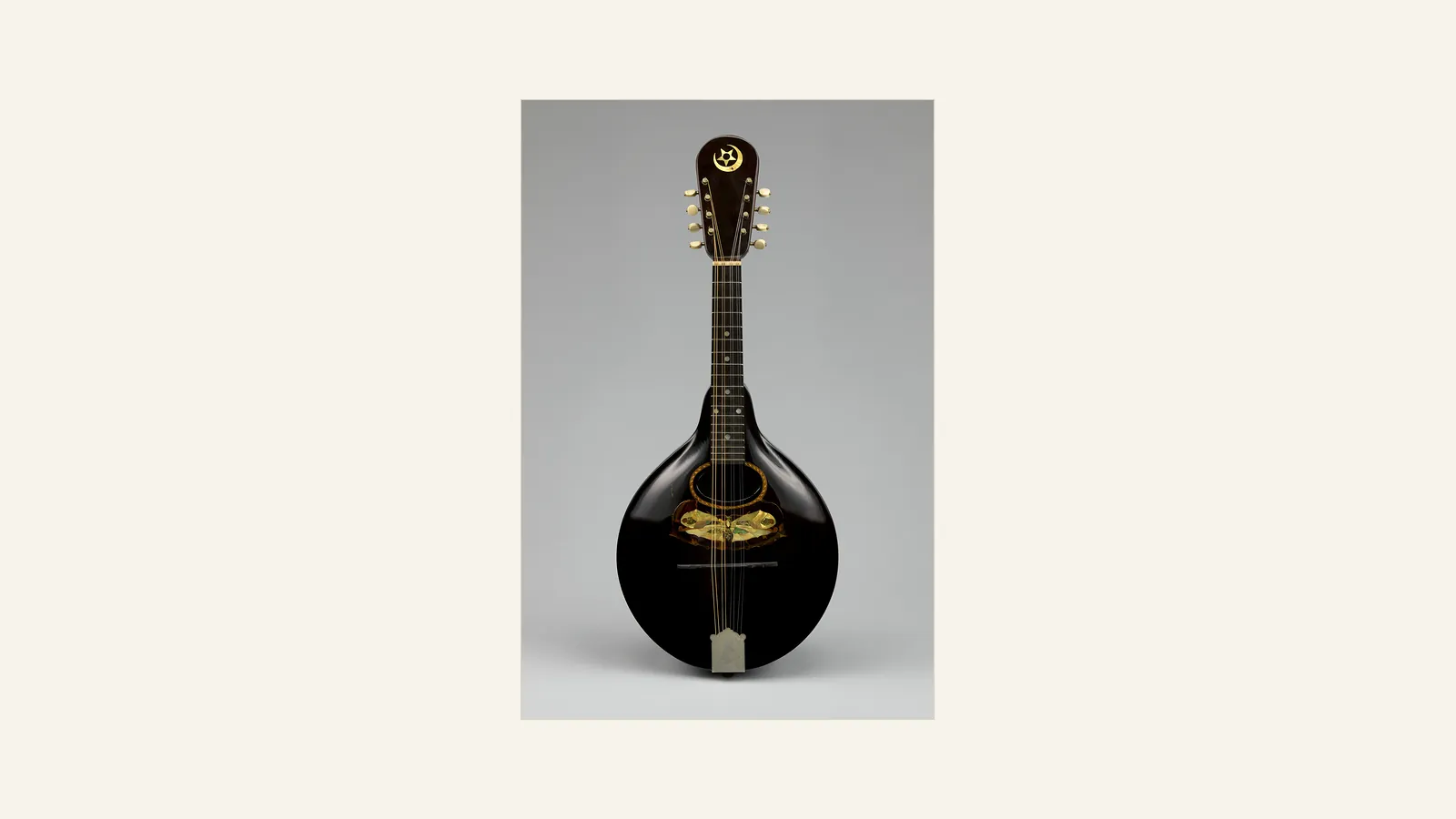
It started with a mandolin. Orville Gibson of Kalamazoo, Michigan was awarded patent 598,245 on February 1, 1898 for a mandolin with a carved top and back, and the patent names guitars, mandolas and lutes too. The top and back were carved, not bent, so the grain layers stayed the way the tree grew them [a man after my own heart, it's the same reason we cut everything Vertical Grain].
The Met has one of his mandolins from about then, carved spruce over carved walnut, no braces inside at all. In 1902 he sold his patent and name to the Kalamazoo backers of the new Gibson Mandolin-Guitar Manufacturing Company, more on Orville Gibson's carved mandolins in another post.
Orville died in 1918, and the next year the company hired Lloyd Loar. In 1922 Gibson brought out its Master Model line, the F-5 mandolin and the L-5 guitar (often written L5) among them, with violin-style f-holes and a fingerboard floating above the top. Acoustic Guitar puts the first L-5 at 16 inches across with a carved spruce top, and Loar's labels said the top, back, tone bars and air chamber had been tested and tuned. Bluegrass players still chase those 1922–23 Loar F-5s, that story is in Lloyd Loar's F-5 mandolin.
Then the bands got big. The Met says the L-5, strummed with a pick, had a bright, percussive tone that cut through even large horn sections. Rhythm players like Freddie Green kept a steady four-to-the-bar, and the makers went bigger, Gibson's Super 400 came in 1934 at 18 inches across and Epiphone's Emperor went 18-1/2. John D'Angelico opened his New York City shop in 1932 building guitars closely modeled on the L-5, more than 1,000 of them by hand. That's the archtop jazz guitar most folks picture.
Then came the pickup. Vintage Guitar dates the first Gibson ES-150 shipment to November 20, 1936, the guitar tied to Charlie Christian, and Gibson put pickups on the L-5 in 1951. Once jazz moved into small clubs the archtop, usually amplified now, became a dominant instrument in bebop and cool jazz, and James D'Aquisto (D'Angelico's old shop boy) kept carved archtops going while most players went electric. The longer story is in our short history of the guitar.
Archtop vs Flat Top: Sound, Strings and Feel
I don't play an instrument myself (never learned), so on sound I'll lean on the people who write about it. The short version of archtop vs flat top is attack against sustain. Acoustic Guitar's Michael John Simmons describes the acoustic archtop's voice as bold and percussive, with strong attack and limited sustain, the note jumps out and clears the way for the next chord. A flat top, with its bridge glued to an X-braced top, rings on longer and fuller, a flat-top dreadnought most of all.
Archtops are strung for drive. Collings ships its carved AT 17 with D'Addario EJ-17 mediums, .013 to .056, and Gibson strings its electric 1957 L-5 CES Reissue with .012 to .052 flatwounds, which Gibson calls light gauge [that tells you where archtop players start]. Add a body 16 to 18 inches wide to reach over and an archtop takes some getting used to. The bridge adjusts though, the L-5 CES has a Tune-O-Matic on a rosewood base with full adjustment for action height and intonation, so a good setup matters a LOT.
As for what archtops are good for, the Met's history says it plainly, rhythm in the big bands and then bebop and cool jazz. Acoustic Guitar's Sean McGowan writes that jazz and swing players have long favored them and roots, Americana, flatpicking and singer-songwriter players are picking them up now. Turned up loud a big hollow body can feed back, Premier Guitar's Jol Dantzig notes some players find pressed laminates more feedback resistant, and Gibson's semi-hollow ES-335 has a solid center block to cut it down (more in the questions below).
How an Archtop Guitar Top Is Carved: Wedge Cut vs Plank Cut
A carved top guitar starts as a lot more wood than it ends with. Our grade sheet lists archtop guitar sets two ways, a wedge cut two-piece bookset, each piece at least 23" x 9", 1 1/8" thick at the joining edge tapering to 3/8" at the outside edge, and a plank cut bookset at the same 23" x 9" but 1 1/8" thick all the way across. Most arch-top tops we cut run 1 1/4" thick x 9" wide, and our 16 inch sets are 22" x 8.25", tapering 1 1/8" to 5/16".
We like the wedge cut. It's closer to the finished profile of the carving, so the builder keeps more symmetry in the carve, and it's a better use of a very precious, limited resource, Old Growth timber. A log is round, and when we're cutting thick rectangular boards the way to get back on Vertical Grain is to cut a wedge. We still cut plank sets on occasion for builders who'd rather not jig up to carve a wedge [a waste of good wood, I think], and most of our archtop customers order the wedge cut.
It makes a better looking instrument in terms of symmetry, because the boards start out closer to the finished profile, there's less carving and less waste, and the lighter sets are cheaper to buy and to ship. The toredo float-log archtop sets in the store are wedge cut now, and they're hard won, the calcium shell deposits lining the toredo holes dull our 23-foot saw blades after just a couple of cuts.
Then the builder takes over. The halves are glued at their thick edges, the arch carved outside and hollowed inside, and the thickness graduated, heavier toward the middle and thinner toward the rim, like Orville's patent said. Benedetto Guitars says its luthiers graduate every soundboard by hand and stop to tap the wood constantly, listening to its pitch change, then brace it with parallel tone bars or an X. Most of that wedge ends up as shavings on the floor.
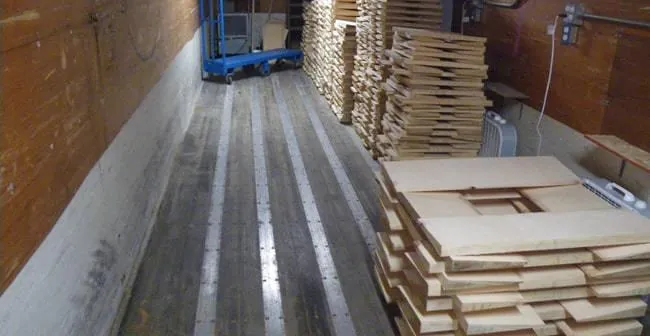
A pressed top skips the carving. Dantzig writes that Gibson took up pressed-arch laminated tops with the ES-175 in 1949, pressing flat sheets into an arch with hydraulic machinery, and that laminated hardwood kept costs down where a carved top starts as a thick piece of spruce. If you're carving, give the stock time when it lands, sticker it with some weight, carved-top stock can take a month or more to acclimate.
Choosing Archtop Guitar Wood: Sitka, European Spruce and Cedar
The usual recipe, Acoustic Guitar says, is a spruce top over maple back and sides, sometimes mahogany or walnut, and Gibson's 1957 L-5 CES Reissue is carved AAA spruce over carved curly maple. Which spruce is the builder's call. Seattle builder Tolley told Fretboard Journal his favorite archtop combination is European spruce and bigleaf maple, and that he's used Engelmann and Sitka to great effect. Collings, writing about flat tops, calls Sitka the industry standard, Adirondack punchy with high headroom, European sweet at the high end and Engelmann noticeably softer than Sitka.
Here are the USDA Wood Handbook numbers (FPL-GTR-282, 2021, Tables 5-3a and 5-3b, at 12% moisture) for the species grown in the United States, European spruce isn't in those tables.
| Species | Specific gravity | Stiffness, MOE (million psi) | MOE (GPa) |
|---|---|---|---|
| Red spruce (Adirondack) | 0.40 | 1.66 | 11.4 |
| Sitka spruce | 0.40 | 1.57 | 10.8 |
| Engelmann spruce | 0.35 | 1.30 | 8.9 |
| Alaska yellow cedar | 0.44 | 1.42 | 9.8 |
| Western red cedar | 0.32 | 1.11 | 7.7 |
Red spruce edges out Sitka as slightly stiffer along the grain at the same weight in the samples tested, Engelmann lighter and softer. Those are averages, every log is different, so I compare stiffness to weight on every board I grade. What Sitka brings to an archtop guitar is size, a wide clear set on VG takes a big tree, and the Old Growth Sitka we salvage AVERAGES about 400 years old.
Our Ultra Light Sitka runs about 16% lighter than common Sitka, some of it with the texture of 200+ year old Norway spruce, and we cut it in archtop sets too. The few luthiers who buy them report amazing tone, a big, loud voice and great responsiveness.
For a softer, less dense top there's cedar. Our EarthTone red cedar archtop fronts, for 17 to 18 inch bodies, are old salvage cedar colored by decades of our 10 feet of rain a year mixing with the cedar oils [time and water, lots of it], though Collings warns cedar lacks spruce's headroom under a heavy hand. We cut Alaska yellow cedar archtop wedges too.
Grade is mostly LOOKS. On our guitar video I called Master Grade the creme de la creme of the 3A sort, perfect VG, strong medularies, no growth lines out of place, even color and texture, a one-in-a-thousand board, then AAA, AA and A, plus bearclaw archtop wedges for the figure folks. Quality must not be misconstrued for Grade, the whole ladder is on our page on how we grade carved tops. What's on the shelf is under carved archtop guitar tops in the store, with a few more sets under the carved-top tonewood tag.
Questions and answers
Why is it called an archtop guitar?
Because the top is arched instead of flat. On an archtop the top, and usually the back, is carved (or on factory guitars pressed) into a low dome like a violin's, and Orville Gibson's 1898 patent describes the front and back boards carved in a somewhat convex form for stiffness. Archtop, arch top or arch-top, it's the same guitar.
What are archtop guitars good for?
Jazz first, and rhythm most of all. The Met says the L-5's bright, percussive tone cut through big-band horn sections, and later the archtop became a dominant instrument in bebop and cool jazz, mostly amplified. Acoustic Guitar adds swing, roots, Americana, flatpicking and singer-songwriter players. Strong attack and limited sustain keep each note clear, which is what you want playing chords in a band.
Are archtop guitars harder to play?
A little, usually, and it's mostly strings and size. Acoustic archtops are strung for drive, Collings ships its AT 17 with .013 to .056 mediums, and Gibson calls the .012 to .052 flatwounds on its L-5 CES light gauge. A body 16 to 18 inches wide is also a lot to reach over. The bridge is adjustable for height and intonation though, so a good setup goes a long way.
What does a semi-hollow guitar sound like?
Somewhere between a hollow archtop and a solid-body electric. Gibson's ES-335, introduced in 1958, has a thin laminated body with f-holes and a solid maple center block down the middle. Gibson says that block gives it the feedback resistance and sustain of a solid body while keeping some of a hollow body's resonance, a best of both worlds design.
What is the holy grail of all guitars?
Depends who you ask and what they play. Gibson itself calls the L-5 the holy grail of hollowbody archtop guitars. Bluegrass mandolin players will tell you a Loar-signed F-5 from 1922 to 1924, and flat-top players have their own answer, the pre-war Martins in our dreadnought guitar post. All of them have one thing in common, a spruce top, and that's the part we cut.


Comments