
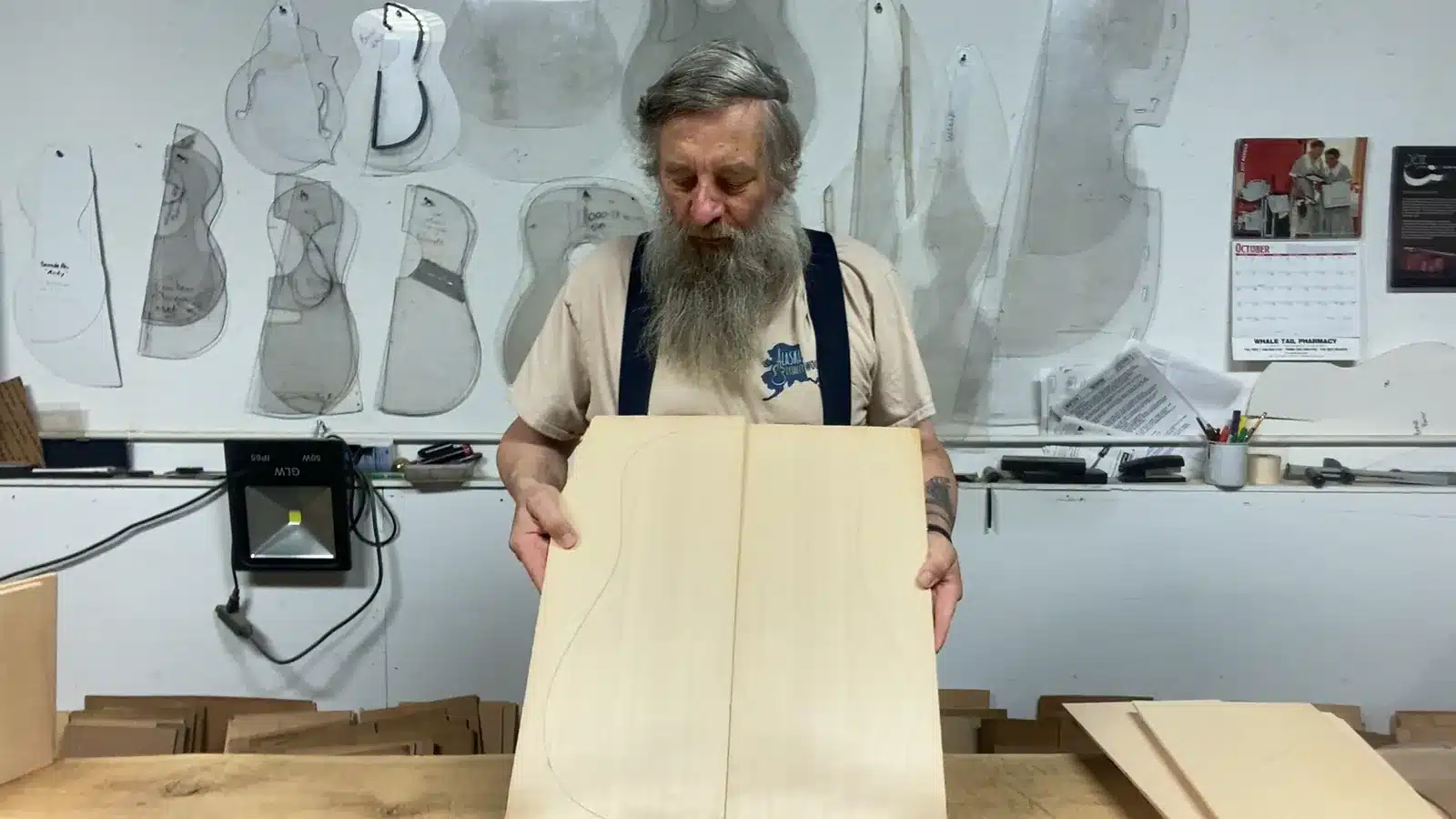
Since 2014 every guitar top we cut has come out of our two-story 60 x 120 ft factory at Port Saint Nicholas Bay on Prince of Wales Island, the material and all the production on the upper level, grading, inventory, shipping and the maintenance shop on the lower level, and every one of those tops has crossed my bench to be graded, board by board. So here’s the plain answer first.
An acoustic guitar soundboard is the top of the guitar, a thin plate of spruce or cedar only about 2.5 to 3mm thick once the builder is done with it, the strings drive it through the bridge, and it makes most of the sound you hear.
If you’re buying an acoustic guitar, the top is where your money should go first. Look for a solid top instead of a laminate, a Vertical Grain cut with no runout, and a board that’s stiff for its weight, then match the body size and bracing to how you play.
I don’t play an instrument myself (never have), so on TONE I go by what builders have taught us over 30 years and by what the physics says. Here’s the longer version, what the soundboard does, how to tell solid from laminate, what grain, stiffness and thickness mean, how body size and bracing change the top’s job, and how we pick a soundboard and what one costs.
What an Acoustic Guitar Soundboard Does
The strings on a guitar make hardly ANY noise on their own. The acoustics lab at the University of New South Wales in Sydney explains that a string is so thin it slips through the air without stirring much of it up, which is why an electric guitar is so quiet unplugged.
On an acoustic the string's vibration goes through the saddle and bridge into the top, and the top, with a whole lot more surface, pushes the air back and forth. That's the job of an acoustic guitar soundboard, turning string energy into moving air, the box doesn't amplify anything the way an amplifier does, it just makes that trade far more efficient.
Taylor Guitars says the same from the builder's side, the top plays a major role in turning the strings' energy into sound, and that's why it's called the soundboard. UNSW adds that the back matters a lot less for most notes (partly because it's held against the player's body), and the air inside helps in the low range, ringing a little like a bottle when you blow across it.
To do all that a top has to move easily and still hold up to the strings. UNSW describes the top plate as usually spruce or another light, springy wood about 2.5mm thick, with braces glued underneath to keep it flat, because the strings are always trying to rotate the saddle and bridge.
Taylor calls spruce by far the most common wood for acoustic guitar tops, and Sitka the most common spruce. We cut Sitka, Western red cedar and Alaska yellow cedar here on Prince of Wales Island from salvage-sourced Old Growth, and what we look for in every block is that light, stiff, straight-grained fiber that makes a good guitar soundboard.
The old version of this page said the kind of tonewood doesn't reflect anything on the sound of the soundboard. I'll set that straight, it does, the species and the cut decide how stiff and how heavy that thin plate is, and that's most of what a top has to offer. There's more in our guide to what tonewood is and how each one sounds.
Solid Top vs Laminate: How to Tell What You're Buying
This is the biggest question in buying an acoustic guitar. A solid top is real wood through its whole thickness, usually two bookmatched halves glued at the center seam. A laminate top is thin sheets bonded together like plywood, and Taylor explains the layers are usually laid with the grain alternating, which makes the panel tough and stable. Some tops aren't even wood. Martin builds its X Series guitars with high-pressure laminate (HPL) tops, and Taylor's Andy Powers describes HPL as compressed paper with a printed veneer on top.
William Cumpiano, a guitar maker and co-author of the 1987 textbook Guitarmaking: Tradition and Technology, wrote the clearest test I know of for Frets magazine back in 1995. Look at the edge of the soundhole. A layered, sandwich look means a laminated top, and if the grain lines on the top run down across the whole thickness of the edge, the soundboard is solid.
If the soundhole edge is painted or covered over, he says don't be fooled, treat it as laminated. The spec sheet helps too, a solid top acoustic guitar with laminate (Taylor says "layered") back and sides still has a solid soundboard, and all solid means solid wood everywhere.
On the sound, Cumpiano was blunt. The big cost in tone comes when the SOUNDBOARD is laminated, laminating the back and sides costs a lot less, so a solid top guitar with laminated back and sides is usually the best sound for the money. That's the honest answer to laminate vs solid wood guitar. In fairness to the laminate guitar, he also wrote that laminated plates won't crack from dryness and take more abuse, which makes a fine knock-about guitar.
A solid spruce top guitar doesn't have to cost a fortune either. Our grading page says manufacturers put our A grade, a top with character that just doesn't have the looks for the next grade up, on instruments ranging from $500 to $1,200. [An A grade top is still a solid, Vertical Grain soundboard, same as our Master Grade, it just isn't as Pretty.] So when you weigh solid wood vs laminate guitar, put the first money into a solid top and keep it humidified so it doesn't crack, our guitar humidity guide covers that.
Grain, Stiffness and Thickness in an Acoustic Guitar Soundboard
Once you know the top is solid, look at how it was cut. EVERY soundboard we make is cut Vertical Grain, the growth rings run straight up and down, square to the face, when you look at the end of the board, a board sold as quartersawn can be as much as 45 degrees off that. Then look for runout.
Paul Hostetter explains on lutherie.net that runout shows up when a cut doesn't follow the wood's natural grain, it happens when you saw wood and is nearly impossible when you split it. Back in 1997 and 1998 we were hand-splitting blocks and billets for builders who cut their own tops, and a split block follows the fiber. Our Sitka spruce guitar tops post goes deeper on vertical grain, runout and ring count.
Stiffness for the weight is the heart of it. A top has to resist the pull of the strings and still move, so builders want the most stiffness for the least weight. The USDA Wood Handbook (FPL-GTR-282, 2021) gives these averages for clear, straight-grained wood:
| Species | Specific gravity | Stiffness along the grain (MOE) |
|---|---|---|
| Sitka spruce | 0.40 | 1.57 million psi (10.8 GPa) |
| Red spruce (sold as Adirondack) | 0.40 | 1.66 million psi (11.4 GPa) |
| Engelmann spruce | 0.35 | 1.30 million psi (8.9 GPa) |
| Western red cedar | 0.32 | 1.11 million psi (7.7 GPa) |
| Alaska yellow cedar | 0.44 | 1.42 million psi (9.8 GPa) |
Red spruce edges out Sitka as slightly stiffer along the grain in the samples tested, and red cedar is lighter and softer than any spruce on the list.
The Handbook doesn't list Norway spruce, the European spruce a lot of the old world makers use, so for that one I went to The Wood Database, which lists both woods tested the same way: Norway spruce at a specific gravity of 0.41 and 1.41 million psi (9.7 GPa), Sitka at 0.42 and 1.60 million psi (11.0 GPa), about the same weight with Sitka the stiffer of the two. Those are averages though, every tree is different, so we weigh the boards themselves. That's how our Ultra Light sort came out of one old Black Bear Creek bridge stringer log, tops about 16% lighter than common Sitka [torrefied Sitka runs about 10% less dense].
Then thickness. We surface most of our flat-top stock to .180" (4.5mm), some may get cleaned up to .160", and either one still leaves lots of meat to work with for a finished soundboard of .105" or less.
Guitar maker Ervin Somogyi traces the published numbers, and Cumpiano and Natelson's book suggests 1/8" (about 3.2mm) for a first steel-string guitar, otherwise anywhere from .095" to .130" (2.4 to 3.3mm) depending on the size, shape and species. Somogyi himself thins his tops to a target deflection under a standard weight instead of a set number, so a stiffer board ends up thinner and lighter, that's why we sort by stiffness and weight and not just by looks.
Body Size, Bracing and How the Top Works With Them
The same top doesn't do the same job in every body. Martin's guide to body sizes sums it up, larger guitars give louder, bass-rich tones and smaller guitars offer balance and clarity. The Dreadnought, with its wide lower bout and deep body, is the big strummer.
Martin built the first dreadnought-size guitars for the Oliver Ditson Company in 1916, its museum ties the idea to a big guitar made that year for the Hawaiian musician Mekia Kealakai and shows a 1929 Ditson 111 as an early example, and the D-18 and D-28 followed in 1931. The 000 and the OM share one body shape (the OM has the longer scale), a mid-size guitar that handles fingerpicking and strumming both. There's more on the dreadnought guitar body in its own post.
When folks ask me how to choose an acoustic guitar, I pass along what our builders tell us, pick the body size that fits you and the way you play, then look at the top. A dreadnought top is a big plate moving a lot of air, a 000 top is a smaller one that Martin hears as more balance and clarity. We cut for both.
A dreadnought bookset from us is at least 22.25" x 8.25" x 3/16" per half, a jumbo half at least 23.5" x 9.5", and the 000/OM, 00, 0 and parlor sets are listed in the store by body size. Dreadnought and 000/OM tops are what we sell the most of. If you're building a smaller body instrument though, I'd highly recommend you PURCHASE the size top made for that instrument, cutting a small body out of a bigger top doesn't save you any money, you're paying for all the extra trim that ends up as scrap destined for the trash can, and it's a poor use of the diminishing Old Growth resource.
Underneath every steel-string top is the bracing. Martin credits its founder, C. F. Martin Sr., with inventing X-bracing in the mid-19th century, two crisscrossing braces under the top, and says it gives the top the balance of strength and flexibility to vibrate freely while it stands up to steel strings. Scalloped braces, shaved lighter, make the top more responsive with more bass and volume, and non-scalloped braces leave a stiffer top with a tighter, more focused sound. Our short history of the guitar covers how the flat top got here.
So the characteristics of a guitar come from the whole system, top, braces, body and the air inside, working TOGETHER. The old Major Factors post on our site put body shape and size first and tonewood second, I'd put the top and its bracing side by side. That's also why we sell Sitka bracewood by the board foot, the braces want the same stiff, straight fiber as the top they hold up.
How We Pick a Soundboard, and What One Costs
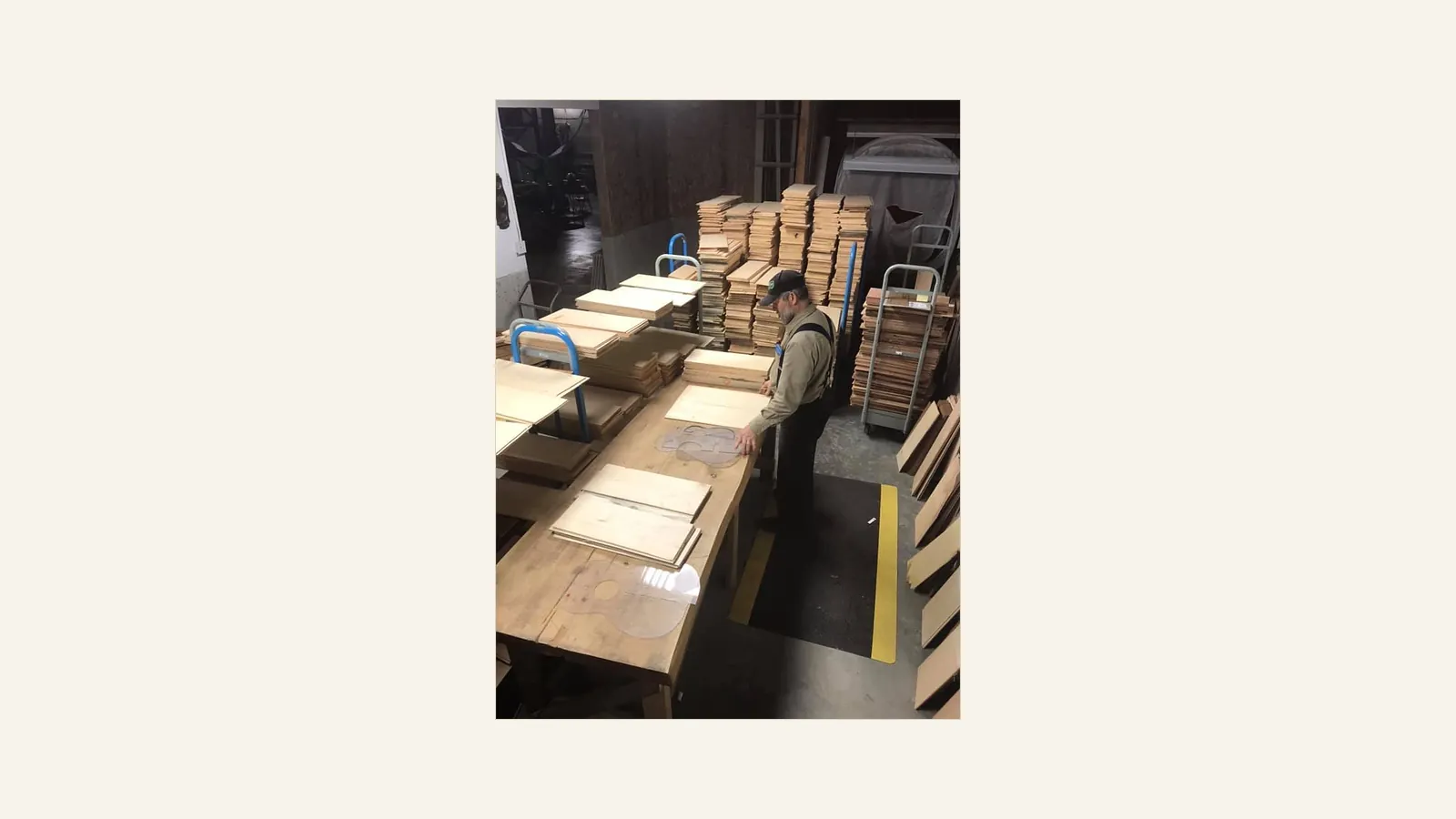
On our end, picking a soundboard starts before there's a board. I read a log by its bark texture and its end grain, and once it's on the mill we follow the fiber, so the tops come off the block Vertical Grain with as little runout as we can manage. Then I grade every top myself. I look at texture (the ring count), the medullary rays (we call them "medularies") and how even the color is, and I compare stiffness to weight.
I don't need to flex and tap test them. We've been producing soundboards for 30+ years and we only produce boards that make the best soundboards out of the material getting dissected into product.
The flex test actually happens at the saw when a block is getting cut, a perfect VG [vertical grain] cut board is automatically stiff as glass, it's when the cutting gets away from VG that Ryan pays attention and decides when to cut a correction wedge out of the block to get back to VG cutting. Tone tapping is a luthier thing, something builders do to decide the thicknessing and voicing of a soundboard, we've already produced the board specifically for a soundboard. The especially light ones go aside, we bring them to near the same dimensions and weigh them to see which make the Ultra Light sort.
Grade is mostly about LOOKS. Master Grade has a usually fine and always very even texture, or a slight graduation from a fine texture of 14 to 20 lines per inch to a bit looser 10 to 14 lines per inch, with medium to strong medularies and consistent color, a one-in-a-thousand top.
AAA is very uniform but lacks that complete consistency, AA is very even with some variation, and A still makes a nice instrument with character. As our grading page says, Quality must not be misconstrued for Grade [the light tops that started our Ultra Light sort would have graded AA by looks]. Our tonewood grades explained post walks through the whole ladder.
Here's what we cut for a bookmatched, non-figured Sitka dreadnought top:
| Grade | Standard | Torrified | Ultra Light |
|---|---|---|---|
| A | Yes | No | Yes |
| AA | Yes | Yes | Yes |
| AAA | Yes | Yes | Yes |
| Master Grade | Yes | Yes | Yes |
We cut the same grades in OM/000 size, and figured Bearclaw and the one-of-a-kind Blue Boards are priced set by set. [Prices move with the stock, so the store always has the current number, and you can see every set we have in our Sitka guitar tops category.] Every one of them goes out as an EarthTone Soundboard, cut from salvage-sourced Old Growth on Prince of Wales Island. Browse our solid Sitka and cedar guitar tops by size and grade, and if you have any questions, email [email protected].
Our grade ladder: Master Grade, AAA, AA and A
Pick a grade to see a real Sitka top and how we define it.
Master Grade
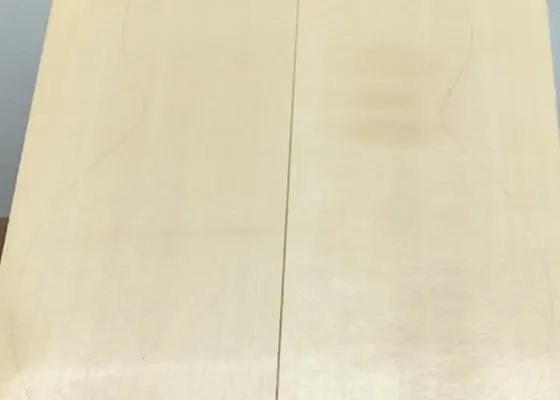
Usually fine and always very even texture, or a slight graduation from a fine texture of 14 to 20 lines per inch to a bit looser 10 to 14 lines per inch, medium to strong medullary rays, consistently even color. A distinguished, one-in-a-thousand top.
A Master Grade set held up in our shop, a frame from our video.
AAA grade
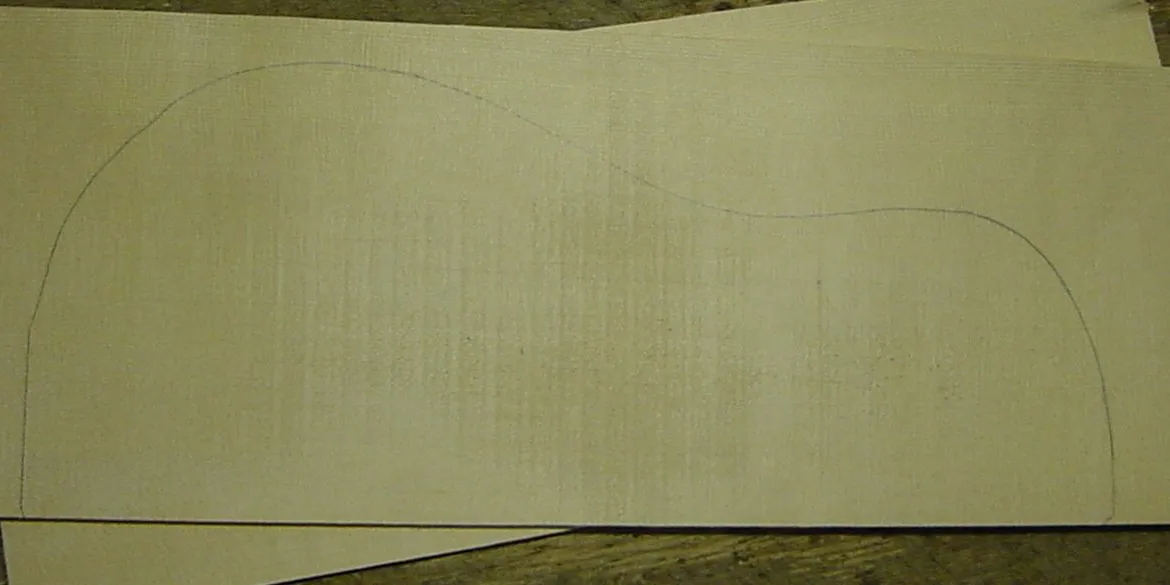
Very uniform texture and color, but lacks the complete consistency of Master Grade.
Photo from our grade page.
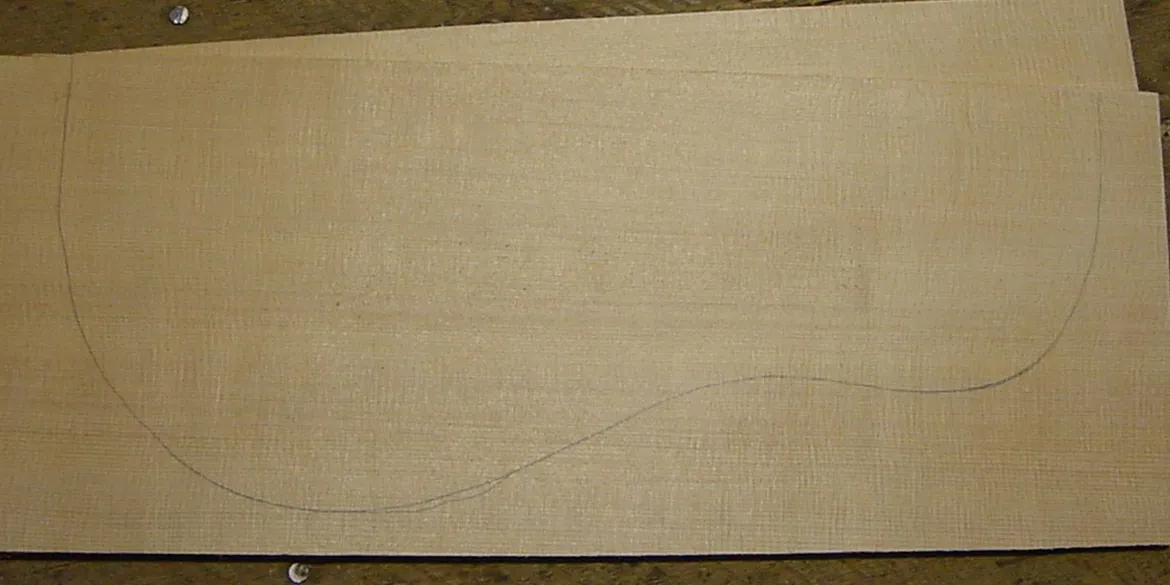
AA grade
Very even texture and color, with some variations that keep it from AAA.
Photo from our grade page.
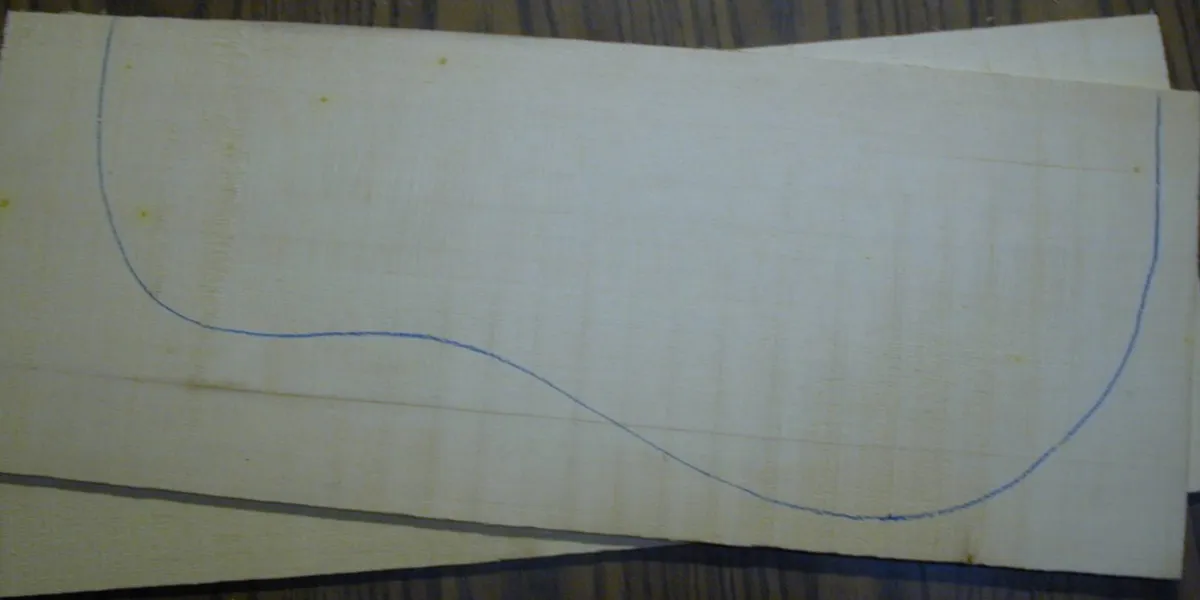
A grade
Still makes a nice instrument with character. Manufacturers use this grade on instruments ranging from $500–$1,200.
Photo from our grade page.
AAA next to AA
Drag the handle, or use the arrow keys.
AA
AAAOlder photos shot under different light, so compare the texture and evenness, not the overall tint.
Grading is about looks (texture, rays, color evenness); quality must not be confused with grade.
Questions and answers
What is the soundboard of an acoustic guitar?
The soundboard is the top of the guitar, the thin plate of spruce or cedar with the soundhole cut in it. The strings pass their vibration through the saddle and bridge into the top, and because the top has so much more surface than a string it moves the air, that's most of the sound you hear. Braces glued underneath keep it flat against the pull of the strings.
What is the most used soundboard?
Spruce, by a long way. Taylor Guitars calls spruce by far the most common wood for acoustic guitar tops and Sitka the most common spruce, and its tonewood guide says Taylor frequently uses spruce or cedar for tops, light yet stiff and strong, with cedar the less dense of the two. You'll also see Engelmann, Lutz and Adirondack spruce. We cut Sitka, Western red cedar and Alaska yellow cedar.
How expensive is a soundboard?
For the raw wood, less than most folks expect. Our tops run from about $10 for a #2 or paint grade top up to about $150 for regularly produced stock, more for the exceptional figured tops and other one-of-a-kinds, which are priced set by set, and the store always shows the current price. Manufacturers use our A grade tops on instruments ranging from $500 to $1,200.
How can I make my acoustic guitar sound better?
Start with fresh strings. Taylor's test is simple, strum a chord and if it sounds lifeless or lacks sustain it's time, and for a casual player every two or three months is plenty. Then have a reputable repair tech go over the frets and action, as William Cumpiano advises, and keep the guitar around 45 to 55% relative humidity like Taylor recommends. The soundboard is the one thing you can't change later, so buy a guitar with a solid top to begin with.
Do guitars actually sound better with age?
Maybe a little, but less than the stories say. Taylor says solid wood keeps improving with age and playing. The best controlled test I know of was on violins. Starting in 2001, a maker built two near-identical violins from the same slab of spruce for a UNSW study, one sat in a Sydney museum and one was played regularly, and after three years panels of experienced violinists rated them about the same.
2 comments
-
-
Nice


great